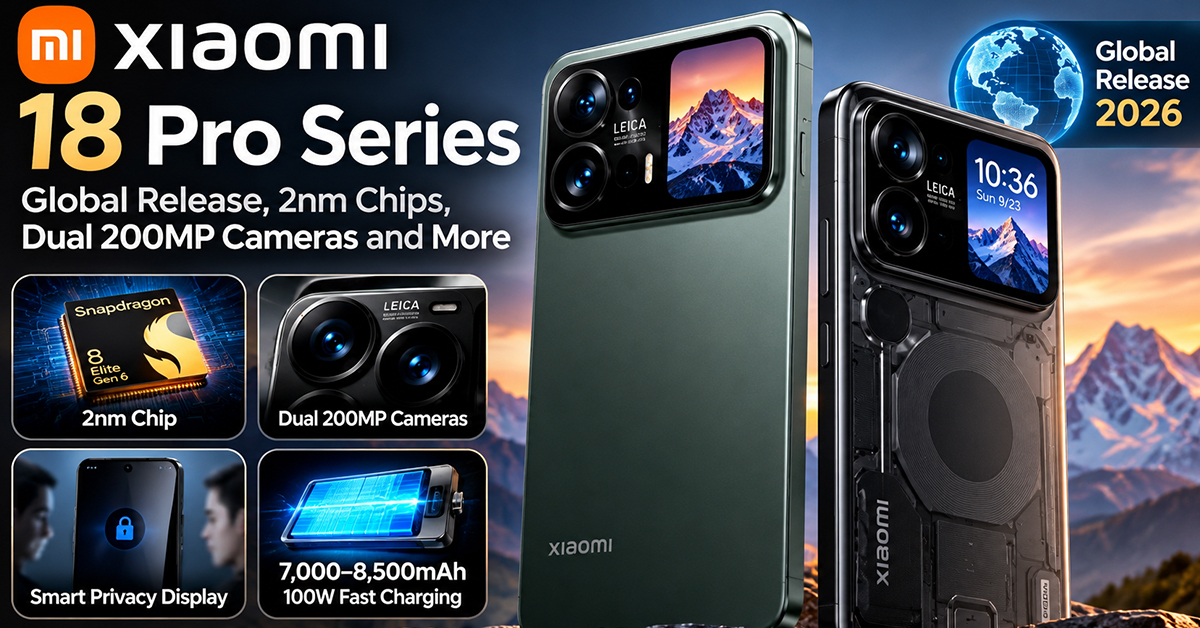
The Xiaomi 18 Pro and Xiaomi 18 Pro Max are attracting attention with their combination of high-resolution cameras, large batteries and a secondary display on the back. Xiaomi has also reportedly confirmed plans to bring the Pro lineup to international markets before the end of 2026.
For buyers outside China, the announcement raises two important questions: which models will actually be available locally, and do the new features offer practical benefits beyond their headline specifications?
Here is a closer look at the reported technology, the differences between the two models and the details international buyers should check before purchasing.
Xiaomi 18 Pro Global Release: What Buyers Should Know
According to the supplied research brief, Xiaomi announced the 18 Pro lineup in Beijing on September 23, 2026, with a global release planned before the end of the year. The announcement would represent a change from the previous generation’s China-focused Pro strategy.
However, a worldwide release announcement does not necessarily mean simultaneous availability in every country.
|
Release detail |
Reported information |
|---|---|
|
China launch |
September 23, 2026 |
|
Global availability |
Before the end of 2026, according to the brief |
|
Models |
Xiaomi 18 Pro and 18 Pro Max |
|
Regional availability |
Exact markets and dates require confirmation |
The distinction matters for buyers in India, Europe and other markets. Xiaomi may offer different models, storage configurations or accessories depending on the region. The Pro Max’s availability should not be assumed simply because the standard Pro is promoted locally.
How the Privacy Display and Rear Screen Could Help
The reported hardware privacy display is one of the lineup’s more unusual features. Traditional smartphone screens can be viewed from an angle, which may expose messages, passwords or other information to people nearby.
A directional privacy display attempts to limit the light reaching viewers outside the intended viewing angle. If implemented effectively, it could make sensitive information harder to read on public transport or in crowded places.
The research brief also describes automatic privacy activation using the front camera and location information. Such features could reduce the need for users to switch privacy settings manually.
However, the claimed visibility reduction to around 1% beyond 60 degrees, along with the precise camera and GPS activation behavior, requires official technical documentation. These figures should not be presented as independently tested results.
The rear OLED display serves a different purpose. It can potentially act as a viewfinder when taking selfies with the main cameras, while widgets and other controls may provide additional convenience.
For photography enthusiasts, using the main rear camera for selfies could be more useful than the secondary screen’s novelty alone. Its actual usefulness will depend on software support and how easily users can access the available functions.
Snapdragon Performance and Dual 200MP Leica Cameras
The supplied specifications identify two different Snapdragon platforms: the Snapdragon 8 Elite Gen 6 for the Pro and the Snapdragon 8 Elite Extreme Gen 6 for the Pro Max. Both are described as using a 2nm manufacturing process.
A smaller chip manufacturing process can allow more transistors to fit within a given area and may improve energy efficiency. It does not, by itself, establish how much faster a phone will be. Cooling, software and sustained workloads also influence performance.
The reported camera configuration is another major feature.
|
Camera |
Reported specification |
|---|---|
|
Main camera |
200MP with optical image stabilization |
|
Periscope telephoto |
200MP, 3.2x optical zoom |
|
Ultra-wide |
50MP |
|
Front camera |
50MP |
A high-resolution main camera can preserve detail, while a dedicated periscope camera provides a separate optical zoom option for distant subjects. Optical image stabilization can help reduce blur caused by small movements.
Still, megapixels alone do not determine photographic quality. Sensor size, lens design, image processing and lighting conditions all affect the results.
The reported 200MP sensor model, 75mm equivalent focal length and 12cm telephoto macro capability should be checked against official specifications before being included as confirmed facts.
Battery Capacity, Charging and Software
The research brief lists a 7,000mAh battery for the Xiaomi 18 Pro and an 8,500mAh battery for the Pro Max, with 100W wired and 50W wireless charging.
|
Feature |
Xiaomi 18 Pro |
Xiaomi 18 Pro Max |
|---|---|---|
|
Battery capacity |
7,000mAh |
8,500mAh |
|
Wired charging |
100W |
100W |
|
Wireless charging |
50W |
50W |
The Pro Max’s reported 1,500mAh capacity advantage could provide additional endurance under comparable conditions. Actual battery life will depend on screen brightness, connectivity, camera use and demanding applications.
The brief also identifies silicon-carbon battery technology, HyperOS 4 and Android 17. These details need confirmation for the specific retail models, including whether international versions receive the same software and charging specifications.
What Readers Should Know
The Xiaomi 18 Pro series is reported to combine advanced camera hardware, large batteries and a privacy-focused display. Those features could appeal to users who prioritize photography, battery capacity and screen privacy.
For international buyers, however, local availability, warranty coverage, network compatibility and final retail prices remain essential considerations. Chinese prices should not be treated as confirmed international prices.
The practical value of the new hardware will become clearer when independent camera, battery and performance tests are available for the international models.