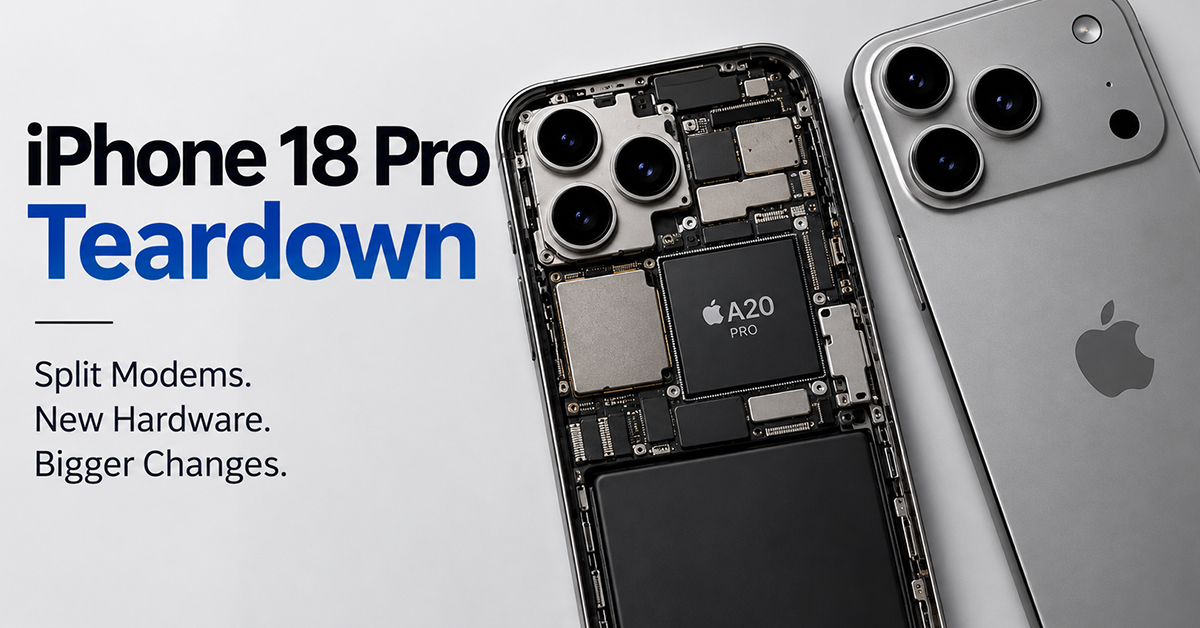
An iPhone 18 Pro teardown has revealed an unusual hardware difference between Apple’s two flagship Pro models. The iPhone 18 Pro uses Apple’s custom C2 modem, while the US-market iPhone 18 Pro Max analyzed in the teardown uses Qualcomm’s Snapdragon X80.
The internal changes go beyond cellular connectivity. The phones also feature Apple’s N1 wireless chip, a six-blade mechanical camera aperture, a larger vapor chamber and a revised internal layout that raises some repairability questions.
Two Pro models, two different 5G modems
The most notable finding is that Apple has not used the same 5G modem across the Pro lineup.
| Model | Modem identified | Other key hardware |
|---|---|---|
| iPhone 18 Pro | Apple C2 | A20 Pro, N1 |
| iPhone 18 Pro Max — US model analyzed | Qualcomm Snapdragon X80 | A20 Pro, N1 |
The supplied research does not establish why Apple adopted this split configuration. It does, however, show that the two models are using different cellular hardware within the same generation.
Apple says its C2 modem uses 15% less energy than the C1X and can support mmWave speeds of up to 2Gbps. Those figures are company claims, not independent measurements from the teardown.
As a result, the available evidence does not yet show whether the C2-equipped iPhone 18 Pro delivers better real-world battery life or cellular performance than the Snapdragon X80-equipped Pro Max.
Apple continues replacing third-party connectivity hardware
The modem is only part of Apple’s move toward custom connectivity silicon.
The iPhone 18 Pro also contains Apple’s N1 chip for Wi-Fi and Bluetooth. This follows Apple’s broader shift toward designing more of the connectivity hardware used inside its phones.
The practical benefit will depend on how the components work together with iOS and other hardware. The supplied teardown research confirms the N1’s presence, but it does not provide independent measurements showing a specific battery-life or connectivity improvement.
The main camera gets a mechanical aperture
The main rear camera uses a six-blade mechanical variable aperture.
Unlike a fixed aperture, this mechanism physically changes the opening through which light enters the camera. That gives the camera hardware additional control over exposure and depth of field.
The teardown confirms the mechanism, but it does not establish how much it improves low-light photography in everyday use. Long-term durability is also still an open question because the research does not provide extended reliability testing.
For now, the important hardware change is the introduction of a physical, adjustable aperture rather than a claim of a specific image-quality improvement.
Battery capacity varies by market
The teardown also identifies different battery capacities depending on the SIM configuration.
| Configuration | iPhone 18 Pro | iPhone 18 Pro Max |
|---|---|---|
| eSIM-only markets | 4,288 mAh | 5,567 mAh |
| Physical SIM + eSIM markets | 4,056 mAh | 5,391 mAh |
The supplied research identifies the eSIM-only configurations as including markets such as the US, Canada, Mexico, Japan and Gulf States.
The higher capacities in those versions indicate that regional internal layouts allow more space to be allocated to the battery. However, the supplied evidence does not establish exactly how much of that difference comes from removing the physical SIM hardware.
A larger vapor chamber addresses heat
Inside the phones, Apple has also expanded the vapor chamber, a cooling component designed to spread heat away from high-temperature areas.
This is particularly relevant to sustained workloads, where heat can become a limiting factor for performance. The research brief does not include independent temperature or sustained-performance measurements, however, so the actual performance benefit cannot yet be quantified.
The teardown confirms the hardware change, but real-world testing will be needed to determine how much it affects gaming, demanding applications or other prolonged workloads.
Repairability remains a concern
The internal design also presents some challenges for repair technicians.
iFixit reported that the plastic display backing frame fractured on three of four test units during screen removal. The teardown research also identifies NAND flash storage within a dual-layer logic-board structure.
Those findings suggest that some repairs could be more complicated than simply replacing an easily accessible component.
However, the three-out-of-four result should not automatically be interpreted as proof of a widespread manufacturing defect. More testing would be needed to determine how representative the result is and how much the disassembly process contributed to the damage.
What the teardown does — and does not — tell us
The iPhone 18 Pro teardown provides a clearer picture of Apple’s hardware strategy, particularly its increasing use of custom connectivity silicon.
But several questions remain unresolved. The supplied research confirms Qualcomm’s X80 in the analyzed US Pro Max, while the modem used in every international Pro Max configuration remains [NEEDS VERIFICATION].
The real-world differences between C2 and Snapdragon X80 performance also remain unconfirmed. Similarly, reports about a future C3 modem for 2027 should be treated as forecasts rather than confirmed Apple specifications.
What Readers Should Know
- The iPhone 18 Pro uses Apple’s C2 modem.
- The analyzed US iPhone 18 Pro Max uses Qualcomm’s Snapdragon X80.
- Apple uses its N1 chip for Wi-Fi and Bluetooth.
- The main camera has a six-blade mechanical variable aperture.
- Battery capacity differs between eSIM-only and physical-SIM configurations.
- A larger vapor chamber is part of the internal thermal design.
- Display-frame damage observed during teardown raises repairability questions.
- Independent testing is still needed to establish real-world differences in modem performance, battery life and camera results.