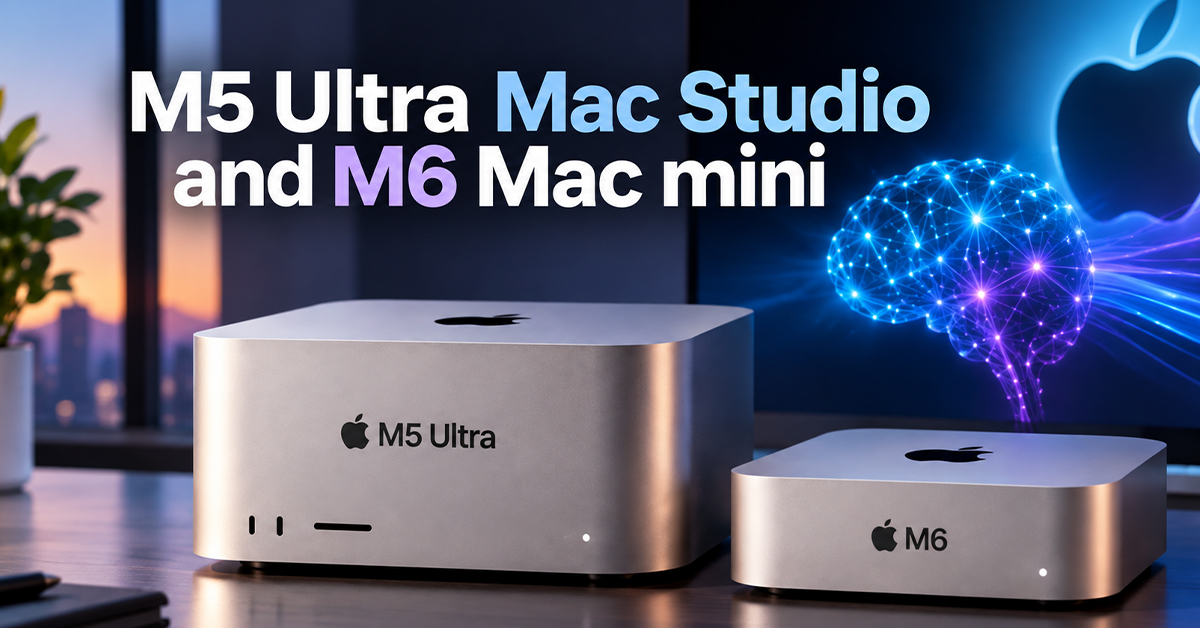
Apple’s new M5 Ultra Mac Studio and M6 Mac mini arrive as local AI workloads are becoming more demanding. The high-end Mac Studio is built around a large unified-memory pool, while the smaller Mac mini brings the M6 architecture to a much lower price point.
For AI users, however, the most important specifications may not be CPU core counts alone. Memory capacity, memory bandwidth and the ability to process long context windows can determine how practical a local AI setup becomes.
Why the M5 Ultra Matters for Local AI
The M5 Ultra combines two dual-die M5 Max chips through Apple’s UltraFusion architecture. It has an 80-core GPU and dedicated neural accelerators within the GPU cores.
The system can be configured with 256GB of unified memory and provides 1.2 TB/s of memory bandwidth. Apple is also scheduled to offer a 512GB configuration in late October 2026.
Unified memory gives the CPU and GPU access to the same large memory pool. That is particularly relevant for AI models that require more memory than a conventional graphics card can provide through dedicated VRAM.
Apple claims the M5 Ultra GPU delivers up to four times the compute performance of the M3 Ultra and up to nine times that of the M1 Ultra. These are Apple’s performance claims, rather than independent benchmark results.
Prefill Is Becoming Important for AI Agents
Local AI performance is easier to understand when divided into two stages: prefill and decode.
Prefill processes the input and existing context before the model begins generating an answer. Decode is the subsequent process of producing the output tokens.
That distinction matters for autonomous coding and research agents. An agent may repeatedly send a large amount of previous context back to the model. As that context grows, processing the input can become a significant part of the total workload.
The supplied research reports approximately 2,887 tokens per second for M5 Ultra prefill at a 16K context, compared with about 1,143 tokens per second for the M3 Ultra [NEEDS VERIFICATION].
For Qwen3.8 Flash-Next, the reported output rate is 108 tokens per second on M5 Ultra versus 70 tokens per second on M3 Ultra.
These results suggest that the M5 Ultra’s advantage can be particularly relevant when workloads repeatedly process large amounts of context.
M5 Ultra vs. RTX 5090
The RTX 5090 presents a different trade-off. The supplied research reports approximately 3,031 tokens per second in prefill and about 59 tokens per second in decode, with roughly 1.79 TB/s of memory bandwidth. These benchmark figures should be independently verified.
| Hardware | Memory | Bandwidth | Reported Prefill |
|---|---|---|---|
| M5 Ultra | Up to 256GB unified memory | 1.2 TB/s | ~2,887 tok/s at 16K |
| M3 Ultra | — | 819 GB/s | ~1,143 tok/s at 16K |
| RTX 5090 | 32GB VRAM | 1.79 TB/s | ~3,031 tok/s |
The RTX 5090 has higher reported raw prefill performance in the cited testing, but its 32GB VRAM capacity is far smaller than the M5 Ultra’s maximum unified-memory configuration.
That doesn’t mean every large model will automatically run well on the Mac. Model size, quantization, software support and data movement all affect real-world performance. The advantage is that Apple provides a much larger memory pool for workloads that need it.
What the M6 Mac mini Changes
The M6 Mac mini starts at $899 with 16GB of memory and a 256GB SSD, according to the supplied research. That’s $300 above the 2024 M4 Mac mini starting price.
The M6 uses a 12-core CPU—two Super cores, four Performance cores and six Efficiency cores—alongside a 12-core GPU.
For local AI, however, the base 16GB configuration is in a very different category from an M5 Ultra with 96GB or 256GB of memory. Buyers interested in running larger models should therefore consider memory capacity before focusing only on the processor generation.
The research brief links the higher prices partly to increases in global RAM costs during 2026. The exact effect of memory pricing on Apple’s product pricing.
Quantization Can Stretch Available Memory
Large AI models do not necessarily have to be stored using their original numerical precision. Quantization reduces the number of bits used to represent model weights, lowering memory requirements at the cost of some precision.
The research also describes hybrid approaches using frameworks such as oMLX, where model weights remain in RAM while supporting data can be offloaded to fast NVMe storage.
SSD storage is still much slower than system memory, so offloading isn’t a free performance boost. Its usefulness depends on which parts of the workload can be moved out of the memory path without creating a new bottleneck.
This approach is one reason large-memory desktop systems can be interesting for local AI even when the model is too large for a conventional GPU’s dedicated VRAM.
Does the M5 Ultra Make Financial Sense?
The answer depends heavily on workload.
A $5,500–$9,500 Mac Studio represents a large upfront hardware cost. Someone using AI occasionally may prefer paying for cloud API usage rather than purchasing dedicated hardware.
The calculation changes for users who run models continuously, need very large context windows, or want workloads to remain on their own machines. In those cases, large local memory and predictable hardware access can have practical value.
Building a multi-Mac Studio cluster is a separate question. The supplied research notes concerns about the economics and reports that real-world stability and scaling require further testing.
What Readers Should Know
The main reason to pay attention to the M5 Ultra Mac Studio for local AI is its combination of high memory bandwidth and a very large unified-memory pool.
The M6 Mac mini serves a different market. Its $899 starting configuration provides a compact entry point, but 16GB of memory places clear limits on the size of AI models it can handle comfortably.
For local AI, GPU speed is only part of the equation. Memory capacity, bandwidth, context size, quantization and software support can determine whether a model is practical to run locally.