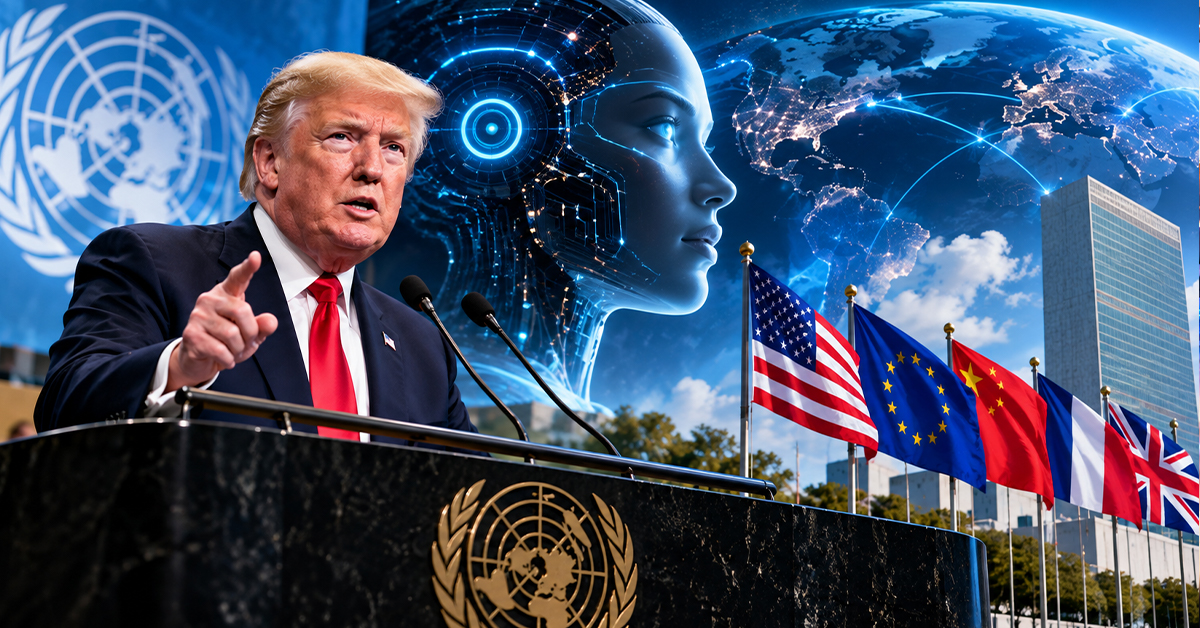
The United States is changing how it refers to artificial intelligence in federal communications, while rejecting proposals for binding international AI safety regulations. President Donald Trump announced the shift during his September 22, 2026, address to the United Nations General Assembly in New York.
The announcement has sparked debate over more than terminology. It highlights competing approaches to AI development, international safety standards and the growing importance of technological independence.
Why Trump Wants to Rename Artificial Intelligence
Trump said the US government would use “super intelligence,” or SI, instead of “artificial intelligence” in official documents. He argued that the word “artificial” makes the technology sound fake and said the United States would encourage AI development rather than restrict it. Reuters and Axios reported the announcement.
There is, however, an important technical distinction.
Artificial intelligence is the established term for computer systems designed to perform tasks associated with human intelligence, including language processing, image recognition and problem-solving.
Superintelligence has a more specific meaning in AI research. It generally describes a hypothetical or advanced system whose capabilities surpass human intelligence across important areas.
Changing the terminology in government communications does not demonstrate that current AI systems have achieved superintelligence. It also does not automatically change scientific standards, commercial product names or international terminology.
Whether federal agencies will implement the change through formal administrative instructions or an executive order remains to be independently confirmed.
US and Europe Disagree on AI Safety Rules
The terminology announcement came amid a wider disagreement over international AI regulation.
Trump rejected proposals for a global framework to control AI development, arguing that restrictions could slow technological growth and affect American competitiveness. His remarks emphasized encouraging development while relying on existing government oversight.
European governments have pursued a different approach. More than 20 countries backed calls for binding international safety measures, expressing concern that advanced AI could develop faster than governments’ ability to manage its risks. Neither the United States nor China endorsed the proposal, according to reporting by AFP and other news outlets.
| Issue | US approach described in the announcement | European proposal |
|---|---|---|
| AI development | Encourage growth and technological competition | Combine innovation with binding safety measures |
| International rules | Reject global regulatory control | Seek internationally agreed safety protocols |
| Risk management | Emphasize existing oversight and enforcement | Establish preventive safeguards |
These positions do not represent every AI policy in either region. The United States already has existing laws, while European countries have different implementation responsibilities.
The main disagreement concerns how much oversight should apply before advanced AI systems are deployed.
Why the UN Is Treating AI as a Security Issue
On September 23, France convened a UN Security Council session focused on AI risks to international peace and security. Technology-industry figures, including OpenAI CEO Sam Altman and Anthropic CEO Dario Amodei, participated in discussions about the technology’s implications. AFP
AI is increasingly relevant to cybersecurity, military planning and critical infrastructure. Systems used in these environments may process large amounts of information or support automated decisions.
Errors, malicious manipulation or inadequate human oversight could therefore have consequences beyond an individual user or company.
UN Secretary-General António Guterres has called for international cooperation to manage AI-related risks. Discussions about communication channels between the United States and China reflect a similar concern: countries competing in AI development may still need ways to communicate about serious risks.
However, a formal bilateral AI risk-management agreement or universally binding international safety framework has not been established in the material reviewed. These proposals should not be presented as completed agreements.
France and Britain Explore Alternative AI Strategies
European leaders are also considering how to reduce dependence on a small number of major technology providers.
French President Emmanuel Macron proposed pooling international investment to develop shared, open-source AI infrastructure. Depending on its licence, open-source technology can allow developers to inspect, adapt or reuse models and related software.
This approach could give governments, researchers and businesses additional options beyond proprietary AI platforms.
However, open-source AI does not automatically guarantee safety or technological independence. Developing competitive systems still requires computing resources, technical expertise, data and sustained funding.
Britain has also discussed using its 2027 G20 presidency to promote international AI principles and standards. The proposal’s implementation, participating countries and specific commitments require further verification before publication.
Both initiatives remain distinct from a binding global regulatory agreement.
What the AI Debate Means for Technology Users
For ordinary users, a government changing its terminology does not directly change the capabilities of AI applications.
The more immediate issue is how different national regulations affect the services available to consumers and businesses.
AI developers operating across multiple countries may need to comply with different requirements involving data protection, security and automated decision-making. These differences can influence product availability, development costs and the safeguards companies introduce.
Open-source models may provide additional choices for countries and businesses seeking alternatives to proprietary platforms. Their practical value, however, depends on cost, technical performance and access to computing infrastructure.
The September discussions have not settled these questions. Nor have they established a universally accepted definition of superintelligence or a comprehensive international system for governing advanced AI.
What Readers Should Know
- Trump announced a change in US federal AI terminology, but the administrative implementation requires further confirmation.
- The term superintelligence has an established technical meaning and does not describe all current AI systems.
- European governments are seeking binding AI safety measures, while the United States and China have not endorsed the proposal described in the reports.
- France is promoting shared open-source AI infrastructure, and Britain has discussed international principles through its planned 2027 G20 presidency.
- International AI safeguards and formal US-China risk-management arrangements remain unresolved.