
Table of Contents
-
Introduction: The Evolution of Translation
-
Key Features of Live Translate
-
How the Technology Works: Preserving Tone and Cadence
-
Launch Details and Future Plans
-
Implications for Global Communication
-
Conclusion: A Seamless Future
1. Introduction: The Evolution of Translation
Google has long been a pioneer in breaking down global language barriers, primarily through its widely used Google Translate application. On Friday, the tech giant announced a significant leap forward with the rollout of a new beta feature that allows users to experience real-time translations directly through headphones. This move underscores Google’s commitment to enhancing its translation and language-learning services, pushing the boundaries of effortless cross-lingual communication.
Rose Yao, Vice President of Product and Search at Google, highlighted the feature’s versatility, noting that it caters to diverse needs, from carrying on a direct conversation in a foreign language to understanding a lecture or watching international media.
2. Key Features of Live Translate
The new feature, dubbed “Live translate,” offers several compelling benefits that set it apart from previous translation methods:
| Feature | Description | Impact on Communication |
| Real-Time Delivery | Translation is rendered instantly as the source language is spoken. | Eliminates awkward pauses and streamlines conversation flow. |
| Tone Preservation | The system maintains the speaker’s original tone, emphasis, and cadence. | Ensures a more natural and less robotic conversational experience. |
| Wide Language Support | The beta supports more than 70 languages at launch. | High utility across various global contexts. |
| Universal Headphone Compatibility | Works with any pair of headphones, not restricted to specific models. | High accessibility for all Android users. |
| Accessibility | Available directly within the Google Translate app. | Easy adoption by the existing user base. |
3. How the Technology Works: Preserving Tone and Cadence
Previous real-time translation tools often delivered a somewhat stilted, monotonous output, stripping away the human elements of speech. The true innovation of Google’s new system lies in its ability to process spoken words and synthesize the translation while preserving the original speaker’s tone, emphasis, and cadence.
This is crucial because communication is not just about words; it’s about how those words are delivered. By maintaining the natural rhythm and emotional context of the speech, Live translate makes foreign conversations far easier and more intuitive to follow, greatly reducing the cognitive load on the listener.
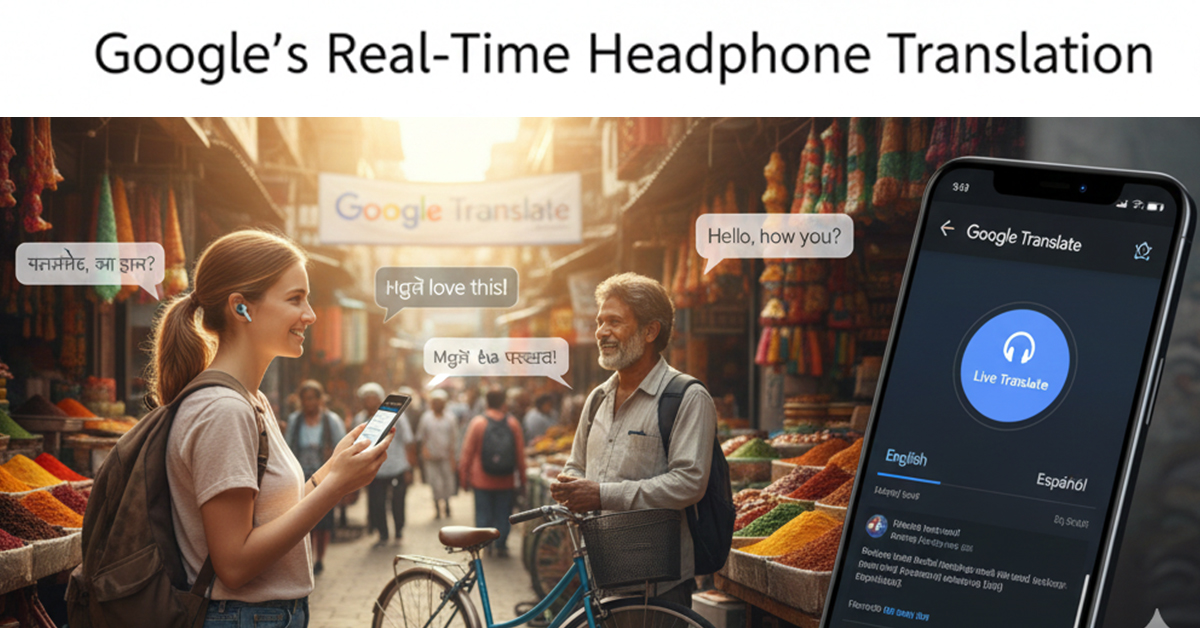
To use the feature, the user simply opens the Google Translate app, taps ‘Live translate,’ and puts in their headphones. The translation stream then begins, allowing the user to hear the foreign speech rendered instantly in their preferred language.
4. Launch Details and Future Plans
The beta version of the real-time headphone translation is currently rolling out on Android devices in three key markets: the United States, Mexico, and India. These initial markets likely provide a rich testing ground due to their linguistic diversity and high Android user base.
Google has already outlined an aggressive roadmap for expanding this service:
-
2026: The company plans to extend the Live translate feature to iOS devices, making it accessible to a much broader user base.
-
Beyond 2026: Further expansion to more countries globally is expected, solidifying the feature’s worldwide reach.
5. Implications for Global Communication
The release of Live translate represents a potential paradigm shift, moving the world closer to a truly seamless, real-time communication environment:
-
Travel and Tourism: It will significantly ease interactions for travelers, from navigating local markets to checking into hotels.
-
Business and Education: Attending international conferences, business meetings, or lectures abroad will become immediately more accessible without relying on dedicated, bulky equipment or human interpreters.
-
Media Consumption: Users can now instantly listen to foreign TV shows, films, or podcasts, opening up vast libraries of international content.
The requirement that the feature works with any headphones is a powerful decision, ensuring that this advanced technology is not locked behind an expensive proprietary hardware requirement, as some competing translation methods have been.
6. Conclusion: A Seamless Future
Google’s beta release of real-time headphone translation is a momentous step in making the world more interconnected. By tackling the complex challenge of preserving human speech nuances while translating instantly, the company has delivered a tool that is not only highly functional but also feels more human. As the feature rolls out to more countries and platforms in 2026, Live translate promises to remove one of the oldest barriers to global understanding—language—making cross-cultural interaction truly effortless.