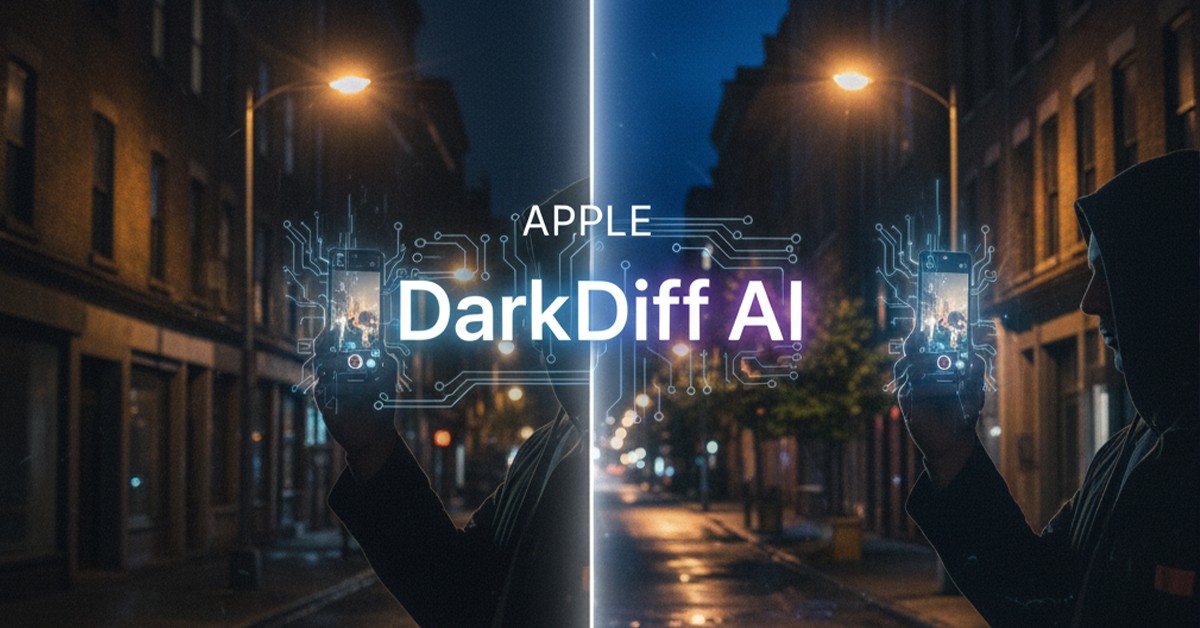

In the world of smartphone photography, the ultimate frontier has always been the dark. While daylight photos across most flagship devices have reached a point of near-perfection, capturing crisp, noise-free, and color-accurate images in low-light environments remains a challenge governed by the laws of physics. Apple Inc., however, is looking to rewrite those laws with its latest technological breakthrough: DarkDiff AI.
Revealed on December 27, 2025, DarkDiff represents a fundamental shift in how iPhones process images. By integrating generative diffusion models directly into the camera’s Image Signal Processor (ISP), Apple is moving beyond traditional “computational photography” and entering the era of “generative imaging.“
The Science Behind DarkDiff: What is Diffusion?
To understand DarkDiff, one must first understand Diffusion Models. These are the same AI architectures that power generative art tools like Midjourney and DALL-E. In simple terms, a diffusion model works by learning how to “de-noise” an image. It starts with a canvas of pure static (noise) and iteratively refines it until a coherent, high-definition image emerges based on learned patterns.
Apple’s DarkDiff applies this logic to photography. When you snap a photo in a dimly lit room, the sensor naturally produces a lot of “grain” or digital noise because it struggles to collect enough photons. Traditional Night Mode tries to fix this by stacking multiple long-exposure shots. DarkDiff, however, uses its generative AI to “predict” and “reconstruct” the missing details in those dark areas, effectively filling in the blanks that the camera sensor couldn’t see.
Integration with the ISP: The Hardware Edge
The most significant aspect of the DarkDiff announcement is its integration with Apple’s custom-designed Image Signal Processor (ISP). Most generative AI tasks usually happen in the cloud or via a separate app, but DarkDiff is baked into the silicon.
By utilizing the Neural Engine in the latest A-series chips, DarkDiff operates in near real-time. This means the “generative” part of the photography happens the moment you press the shutter button. This tight integration allows Apple to balance the high power demands of diffusion models with the efficiency needed to keep the device from overheating.
Key Benefits of DarkDiff Technology
-
Noise Elimination without Blur: Traditional noise reduction often results in a “watercolor effect” where fine details (like skin texture or fabric) are smoothed out. DarkDiff reconstructs those textures rather than just blurring the noise away.
-
Color Accuracy in Near Darkness: Low-light shots often suffer from “color cast” or desaturation. DarkDiff’s generative model has been trained on millions of high-quality images, allowing it to accurately predict what colors should look like under various lighting conditions.
-
Faster “Shutter” Speeds at Night: Because the AI can handle more noise, users may not need to hold their phones still for 3–5 seconds for a Night Mode shot. DarkDiff can achieve superior results with much shorter exposure times, reducing motion blur from shaky hands.
The Ethical Debate: Is it Still a “Photo”?
As with any generative technology, Apple’s DarkDiff is sparking a debate among photography purists. If an AI is “predicting” and “generating” details that the lens didn’t actually capture, is the resulting image still a photograph, or is it a digital recreation?
Apple’s stance is that DarkDiff is an evolution of the “Deep Fusion” and “Smart HDR” technologies they have used for years. The company emphasizes that the AI is guided by the actual light data captured by the sensor, ensuring that the final image remains an authentic representation of the moment, just enhanced for clarity.
Impact on the Smartphone Market
Apple’s move puts immense pressure on rivals like Google and Samsung. Google’s “Night Sight” has long been the gold standard for low-light imaging, but it relies largely on stacking and traditional algorithms. By moving to a full generative diffusion model, Apple is attempting to leapfrog the competition.
For the average user on NextGenZLife, this means that the “bad lighting” excuse for a ruined photo is becoming a thing of the past. Whether you are at a dimly lit concert, a late-night bonfire, or a dark city street, DarkDiff aims to make your iPhone see better than the human eye.
Future Outlook: DarkDiff in Video
While the current announcement focuses on still photography, industry insiders suggest that the real “Holy Grail” will be applying DarkDiff to video. Currently, generative diffusion is too computationally expensive to apply to 60 frames per second. However, as Apple’s silicon continues to evolve, we can expect a “DarkDiff Video” mode in the coming years, which would revolutionize mobile cinematography.
Conclusion
Apple’s DarkDiff AI is more than just a software update; it is a declaration that the future of photography is generative. By marrying the precision of Apple’s ISP with the imaginative power of diffusion models, the iPhone is no longer just capturing light—it is understanding and reconstructing it.
As we look toward the 2026 iPhone lineup, DarkDiff will undoubtedly be the flagship feature that redefines what we expect from a pocket-sized camera. For the NextGenZ creators who live their lives through a lens, the world just got a whole lot brighter—even in the dark.
WordPress SEO Guidelines for this Post:
-
Focus Keyword: Slug: apple-darkdiff-ai-low-light-photography
-
Meta Description: Apple introduces DarkDiff AI, a revolutionary generative diffusion model integrated into the iPhone ISP to enhance low-light photography. Learn how it works!
-
Tags: #
Suggested Feature Image Concept for LG & Apple Posts
Since you asked for a “Feature Image” earlier, here is a combined strategy for your tech articles:
-
For the LG Article: A sleek, glowing 27-inch monitor showing a high-speed racing game with the text “720Hz OLED” glowing in neon blue.
-
For the Apple Article: A split-screen image. On the left, a grainy, dark photo of a city street. On the right, a crystal-clear, vibrant version of the same street with the “DarkDiff” logo in the center.
Would you like me to generate a specific Feature Image for this Apple DarkDiff article now?